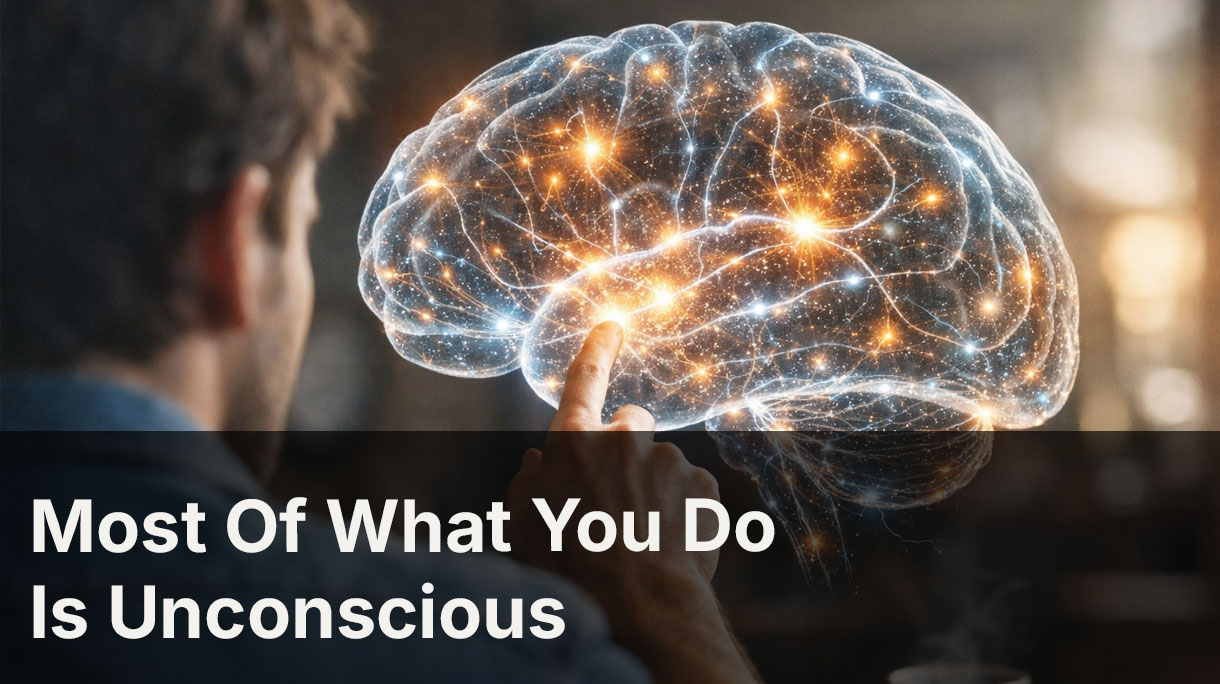
Most of What You Do Is Unconscious
If it feels automatic, it probably is.
Most people assume they are consciously choosing how they act, react, and decide throughout the day. In reality, the majority of what you do happens before conscious thought ever shows up.
That can feel unsettling at first. But it’s also the key to real change.
You React Faster Than You Can Think
Have you ever noticed how quickly your body responds to certain situations? Stress shows up before you can reason with it. Anxiety hits before you can calm yourself down. You react, and only afterward do you think, “Why did I do that?”
That’s not a lack of discipline or awareness. That’s how the brain works.
Roughly 95 percent of daily behavior is unconscious. Simple things like which shoe you put on first, the route you drive without thinking, or how you brush your teeth are all handled automatically. Your brain doesn’t waste energy making decisions it doesn’t need to make.
The same system runs emotional responses.
The Brain Is Built for Efficiency
The brain’s primary job is to conserve energy and keep you functioning. To do that, it turns repeated experiences into patterns. Once something is familiar, it becomes automatic.
That includes how you respond under pressure.
Stress reactions, anxiety responses, avoidance, procrastination, and even confidence patterns are often learned unconsciously over time. They run fast, quietly, and efficiently.
By the time you’re aware of what’s happening, your body is already in motion.
That’s why reactions can feel so hard to interrupt. Not because you’re doing something wrong, but because awareness comes after action.
Why Willpower Feels Exhausting
Most people try to change unconscious behavior using conscious effort. They push harder. They try to think differently. They rely on willpower.
That usually leads to frustration.
If behavior is mostly unconscious, effort alone will always feel like an uphill battle. You’re asking the thinking part of the mind to override a system that’s already running.
That doesn’t mean change is impossible. It means it happens differently than most people expect.
The Same System That Learned the Pattern Can Update It
Here’s the part that often gets missed.
If your behaviors are largely unconscious, then change doesn’t have to come from constant effort or force. The same part of the mind that learned the pattern in the first place also knows how to update it.
The unconscious mind isn’t the enemy. It’s adaptive. It learns quickly. It responds to experience, not lectures.
When understanding reaches that level, patterns begin to shift naturally. Not because you’re forcing them to change, but because the system recognizes something new.
What This Changes for You
When you stop treating automatic reactions as failures, something relaxes. You no longer have to manage every response or fight yourself all day long.
Instead of asking, “Why can’t I control this?” the question becomes, “What is this pattern doing, and how did it learn that?”
That shift alone creates space.
And in that space, change becomes easier. More cooperative. More sustainable.
Most change doesn’t start with thinking harder.
It starts with understanding how your mind actually works.
If You Want Support
If your reactions feel automatic and hard to change, you don’t have to figure it out alone.
I help professionals work with their unconscious patterns so change stops feeling like a fight.
If you want help getting there, schedule a session and we’ll talk.
Let’s get you back into yourself.